Technical buyer guide · 2026-11-24
Dual-Purpose Motorcycle Tires for City & Adventure: Wholesale Spec & Tread Pattern Guide
Direct Chinese manufacturer supply of dual-purpose motorcycle tires (6PR/8PR). Compare 50/50 vs 70/30 tread patterns, container doubling loading, and OEM pricing from Qingdao Port.
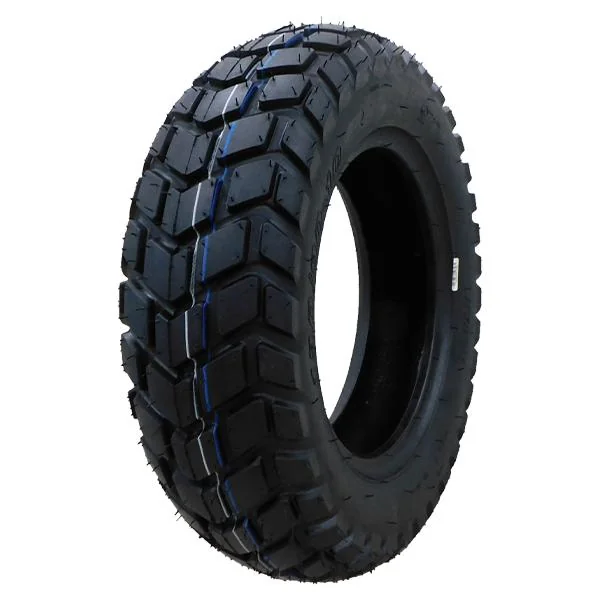
Dual-purpose motorcycle tires must do two jobs without pretending that one tread can be perfect everywhere. For importers and distributors, the commercial decision is not simply "knobby or street." It is a controlled choice between road manners, loose-surface traction, casing strength, market-specific markings and container efficiency.
This guide provides a wholesale specification framework for city, adventure and mixed-road programs. Every final construction, compound, certification and packing claim must be confirmed against the selected pattern and size in the written quotation.
Understanding dual-purpose tires: 50/50 versus 70/30
A 50/50 on-road/off-road pattern normally uses wider block spacing, more open shoulders and stronger self-cleaning geometry. It is intended for buyers whose customers regularly move between asphalt, gravel, hardpack and unsealed roads. The trade-off can be more road noise and less continuous rubber contact than a road-oriented pattern.
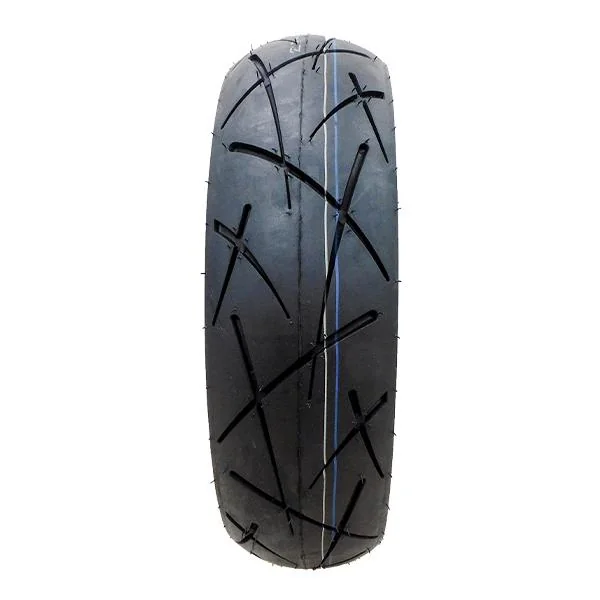
A 70/30 city/adventure pattern places more emphasis on paved-road stability, predictable cornering and water evacuation while retaining enough block definition for occasional gravel or construction-road use. It is often the more practical program for commuter and delivery markets that want an adventure appearance without giving up everyday road behavior.
Before choosing either mix, state the target vehicle class, front or rear position, annual road/dirt split, climate, load, expected speed and local marking requirements. Pattern labels such as 50/50 and 70/30 are sourcing descriptions, not substitutes for a model-level specification.
Key manufacturing specifications to confirm
For demanding replacement markets, a 6PR reinforced casing is a common purchasing target, while selected utility applications may request an 8PR option. A higher PR number is not automatically better: the approved load index, inflation pressure, heat behavior, ride requirement and rim must be considered together.
Buyers sometimes specify 45%-50% natural-rubber content as a formulation target for grip, flex-fatigue resistance and casing durability. This percentage must be documented for the exact compound and production program; it should not be assumed across every tread or sidewall formulation.
The RFQ should also define:
- TT or TL construction and compatible rim type.
- Ply rating, load index, speed rating and approved inflation pressure.
- Tread and sidewall compound targets, including any natural-rubber requirement.
- Bead, breaker and carcass reinforcement appropriate to the application.
- Puncture-resistance and endurance test scope, with acceptance criteria.
- Required DOT or other destination-market marking for the exact SKU.
Popular dual-purpose sizes and catalog rating references
The following load and speed references come from the recovered factory pattern catalog. They are useful for shortlist building, but the final sidewall marking and available construction must be reconfirmed before order.
| Popular size | Catalog load index | Catalog speed rating | Typical sourcing position | Buyer confirmation |
|---|---|---|---|---|
| 2.75-21 | 45 | L | Narrow front adventure / trail | Pattern, TT/TL, PR and rim fitment |
| 4.10-18 | 60 | M | Rear mixed-road / utility | Pattern, 6PR target and load requirement |
| 90/90-19 | 57 | M | Front adventure / dual-sport | Pattern, construction and marking scope |
| 110/90-17 | 60 | P | Rear city / adventure | Pattern, road-dirt split and sidewall marking |
Do not combine a size from one pattern with the rating of another without written factory confirmation. Samples, production drawings and marked-sidewall photos should match the quotation line.
Tread-pattern evaluation for distributors
Evaluate the center zone, transition blocks and shoulder together. A continuous or closely supported center improves road stability and wear consistency. Open intermediate grooves help evacuate water and loose material. Strong shoulder blocks support traction when the motorcycle leans or exits a soft surface.
For a distributor range, consider a three-level assortment:
- A road-oriented 70/30 pattern for commuter and delivery volume.
- A balanced 50/50 pattern for general adventure replacement demand.
- A more open off-road pattern for markets with significant unsealed-road use.
This approach controls inventory better than buying many visually similar patterns without a clear customer segment.
Logistics advantage: 1-in-3 and 1-in-5 nesting
Motorcycle tires consume container cube quickly when individually packed. Compatible sizes can sometimes be nested as 1-in-3 or 1-in-5, placing smaller tires inside progressively larger casings. A carefully engineered program may reduce modeled sea-freight cost per tire by up to 35% compared with individual packing, but this is not a guaranteed saving.
The loading calculation must account for bead protection, deformation risk, tube packing, unloading labor, destination rules and the real SKU mix. The final 40HQ quantity should be calculated line by line after the buyer approves sizes, patterns and packing.
Ask for a loading sheet showing each SKU, packing method, estimated pieces, gross-weight assumptions and a tolerance for production variation. A single headline container number without a buy list is not a reliable quotation.
OEM and private-label purchasing checklist
Private-label buyers should send the brand artwork, sidewall wording, color-film or wrapper requirement, destination market and annual forecast with the initial RFQ. Standard wholesale orders begin from the applicable model MOQ, while OEM programs require confirmation of the model minimum, mold availability and artwork approval process.
Before paying a deposit, require the quotation to state:
- Pattern code and size for every line.
- Construction, PR, load and speed marking.
- TT/TL requirement and any tube supply.
- Applicable certification or marking scope.
- Compound or natural-rubber target where contractually required.
- Packing, nesting method and estimated container quantity.
- Inspection plan, production lead time and Qingdao export terms.
Request a dual-purpose wholesale quotation
Use the motorcycle tire wholesale catalog to shortlist patterns, then start an export RFQ with the required sizes, market and annual volume. For a faster discussion, chat with the Qingdao export team on WhatsApp.
Frequently asked questions
What is the difference between a 50/50 and a 70/30 dual-purpose motorcycle tire?
A 50/50 tire balances paved-road and loose-surface use, while a 70/30 city/adventure tire gives more priority to road stability, noise control and wet-road drainage. The final pattern must be matched to the target motorcycle, terrain and market.
Are 6PR and 8PR available for every dual-purpose size?
No. Ply rating, load index, speed rating, TT or TL construction and sidewall marking must be confirmed for each pattern-size combination in the written quotation.
How many dual-purpose motorcycle tires fit in a 40HQ container?
There is no universal quantity. Compatible tire mixes may use 1-in-3 or 1-in-5 nesting, but the final count and freight saving depend on size, bead protection, tubes, packing and the approved SKU list.
Can Global Excel Tyres supply private-label dual-purpose tires?
OEM and private-label programs are available from the applicable model MOQ. Submit the size list, pattern intent, sidewall brand, packaging, certification scope and destination market for written confirmation.